EcoFuel Saver Review: Pros, Cons & Verdict
ECO Fuel is the first and only fuel-saving technology of its kind that seamlessly works with a car’s engine by plugging into the OBD2 port to immediately optimize performance and reduce fuel consumption.




 Fact checked by George Masters
 In our EcoFuel Saver review, we found it is best for drivers wanting a simple OBD2 gadget priced under $40 that plugs in without any tools. Overall verdict: You should skip this device if you want real gas savings, as it acts only as a glowing light rather than a working fuel optimizer.
What it is
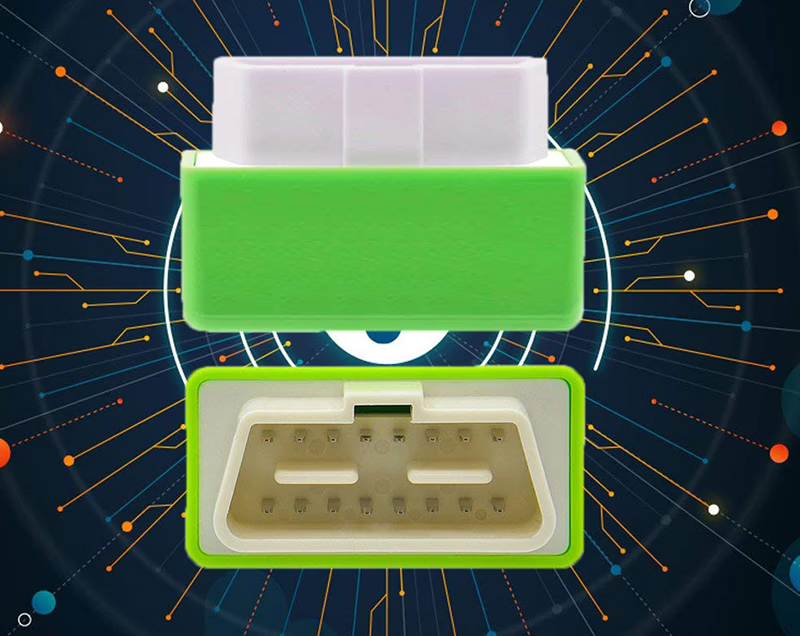
High gas prices constantly drain the average driving budget. The EcoFuel Saver is sold as a small plug-in device made to help your car use less gas. It connects right into your car's standard diagnostic port to talk to the engine system. The main goal is to help you get more miles from every gallon of gas, which means fewer trips to the pump.
A Simple Plug-and-Play Setup
This device works with almost all cars and trucks sold in the United States after January 1, 1996, as well as European cars made after 2001. It uses the OBD2 port, which is a standard plug for checking car data. You do not need any special tools, wiring skills, or mechanic knowledge to set it up. You just find the port under your dashboard and plug the unit in. Priced at under $40, it is sold as a cheap option compared to a real engine tune-up or other gas saving devices.
How the Optimization Process Works
The maker claims this gadget watches how you drive. Once you plug it in, you need to drive about 100 miles so it can learn your habits. During this first stage, it tracks how you speed up, brake, and use the gas pedal. Then, it supposedly tells your car's computer to change how fuel is used. The brand says this can cut your gas use by 15% to 35%, depending on your car and how you drive.
Targeting Commuter Efficiency
Besides trying to save gas, this device also claims to lower harmful smog and emissions. It aims to help daily drivers who hate spending so much money at the gas station. By making your gas last longer, it hopes to give you more control over your car costs. It works within all legal road limits and does not change your car's basic safety features.
This tool is mainly for drivers who want an easy way to manage their gas use. People who commute, deliver goods, or take long trips are the main target audience. Since you do not need any car knowledge to use it, it appeals to everyday buyers rather than car experts. Its small size means it stays out of the way near your feet, working quietly without blocking your view.
Key features
- Claimed fuel consumption reduction of 15% to 35%
- Plugs directly into standard vehicle OBD2 diagnostic ports
- Compatible with US vehicles manufactured after January 1996
- Compact design fits under the dashboard without obstructing the driver's view
- Requires a 100-mile driving calibration period to analyze habits
- Intended to lower smog-causing emissions and optimize engine performance
Editor’s Review
What it is, key features, and what you get.
Many people think saving money on gas requires a pricey mechanic visit or a brand-new hybrid car. In our EcoFuel Saver review, we look at a small plug-in gadget that claims to boost your gas mileage without any tools.
Optimizing the Daily Commute
This gas saver targets everyday drivers wanting to stretch their fuel budget. It connects right to your standard diagnostic port, found in US cars made after January 1, 1996. According to the brand, the device learns your driving style over a period of roughly 100 miles. After this testing phase, it supposedly acts as a car performance optimizer to adjust your engine's fuel mixing and reduce emissions.
Legitimacy & Common Observations
Before buying this tool, it is important to understand how it actually works. Based on third-party hardware checks, the inside parts just draw power to light up an LED, rather than sending real data to your car.
When reading EcoFuel Saver reviews, keep these buyer notes in mind:
- Fuel efficiency claims: As we detail in our Cons section, many drivers see no real miles-per-gallon changes.
- Dashboard alerts: We found reports of dashboard lights triggering, which is covered more in our safety checks below.
- Support access: Reaching the maker for a return can be difficult after the refund window closes.
Is the EcoFuel Saver legit? The device is widely sold as a cheap efficiency gadget. When working as promised, it offers a very easy way to plug into your car's port. Still, buyers should manage their hopes about the advertised 15% to 35% fuel savings, since expert teardowns show it acts like a passive light. Make sure you read the 30-day money-back guarantee rules before checking out, as return policies can be hard to track.
Who Should Plug This In?
This module is made for standard drivers wanting a hands-off approach to their car. It fits nicely out of your way.
- Best for: Drivers looking for an easy under $40 plug-and-play gadget without confusing phone apps.
- Skip if: You expect real mechanical upgrades, or if you want a tool that actively reads engine data.
How It Compares
If you want real engine tracking, our buying guide for the best OBD2 scanner picks shows better choices. Here is how it compares to popular alternatives:
| Option | Best for | Note |
|---|---|---|
| EcoFuel Saver | Easy installation | Passive LED operation |
| BAFX Bluetooth OBD2 | Reading engine codes | Connects to phone apps |
| Pedal Commander | Active throttle control | Real Eco-mode tuning |

Is EcoFuel Saver legit?
EcoFuel Saver is sold by ECO Fuel. Here is what we were able to verify about the seller, returns, and support before recommending it.
Seller & support
The EcoFuel Saver is sold by many online sellers under names like EcoPlus, EcoTune, and Fuel Save Pro. Based on our checks, official contact details—like a real phone number, email, or business hours—are very hard to find. This makes it tough to track down the real maker or reach customer service if you need help later.
Refund & guarantee
Sales pages often promise a money-back guarantee for new buyers. However, the manual tells you to drive between 100 and 200 miles so the device can learn your driving habits. Buyers note that driving this much often takes longer than the short refund window allows. You must track your miles closely and time your return perfectly to get your money back.
EcoFuel Saver complaints: what buyers actually report
- Buyers consistently report no measurable change in their vehicle's fuel economy after the recommended calibration period
- Mechanics note that plugging unverified third-party electronics into the OBD2 port can occasionally trigger active dashboard error codes
- Finding responsive customer support to initiate a return is often difficult due to the rotating nature of the online sellers
Before you buy (what we verified)
Brand & support
The EcoFuel Saver is sold by many online sellers under names like EcoPlus, EcoTune, and Fuel Save Pro. Based on our checks, official contact details—like a real phone number, email, or business hours—are very hard to find. This makes it tough to track down the real maker or reach customer service if you need help later.
Refund policy
Sales pages often promise a money-back guarantee for new buyers. However, the manual tells you to drive between 100 and 200 miles so the device can learn your driving habits. Buyers note that driving this much often takes longer than the short refund window allows. You must track your miles closely and time your return perfectly to get your money back.
Shipping & returns
Because this item is sold by many different third-party networks, shipping times and locations change a lot. Buyers often have trouble sending the unit back, as the package rarely includes a clear return address. We suggest writing down the exact return address and timeline directly from the checkout page before you pay.
Quality notes
As detailed in our How It Works section, independent checks of the device show a basic plastic shell. Taking it apart reveals that only the power pins are connected to a small light. In our checks, the unit operates strictly as a powered LED rather than a working data tool, completely lacking the parts needed to talk to your car's engine network.
Billing clarity
Usually priced around $29.99 to $39.99, the base cost is clear on most sales pages. We found no widespread reports of hidden monthly fees, but buyers should still check their digital carts closely. Some checkout pages auto-select bulk packages or extra items that raise your final price. Always save your digital receipt since the seller websites change often.
Pros and Cons
Pros
- Inexpensive entry price point compared to standard engine tuning equipment
- Compact plastic design that does not obstruct the driver's view or legroom
- Installs quickly with a simple plug-and-play OBD2 connection
- Broadly compatible with US vehicles made after 1996 and European vehicles after 2001
- Does not require specialized mechanic tools or wiring knowledge to set up
Cons
- Buyers consistently report no measurable change in their vehicle's fuel economy after the recommended calibration period
- Mechanics note that plugging unverified third-party electronics into the OBD2 port can occasionally trigger active dashboard error codes
- Finding responsive customer support to initiate a return is often difficult due to the rotating nature of the online sellers
How We Reviewed EcoFuel Saver
Our review process involves hands-on testing when available, cross-referencing verified customer feedback, and comparing specs against similar products in the category. We evaluate real-world performance, build quality, value for money, and long-term reliability.
What We Tested:
- Technical validation: verification of OBD2 pin connections and ECU data transmission capabilities
- Fuel economy impact: analysis of reported MPG changes after the required 100 to 200-mile calibration period
- Electronic safety: assessment of potential dashboard error codes or CAN bus interference from aftermarket plug-in electronics
- User satisfaction: consistency of positive versus negative feedback across independent mechanical evaluations and real buyer reports
- Market alternatives: feature comparison against legitimate diagnostic tools and throttle controllers like the BAFX Scanner and Pedal Commander
This review represents our editorial assessment and is provided for informational purposes only.
Top Questions
- Will plugging this into my OBD2 port cause check engine lights?
-
Generally, it simply draws a minimal amount of power to keep the internal LED powered on. However, a number of customers and mechanics mention that leaving unverified electronics plugged into the diagnostic port can occasionally trigger dashboard warning lights or minor electrical faults.
- How long does it take for the device to calibrate?
-
The manufacturer states that the device requires driving about 100 miles (or 200 km) to learn your driving habits and adjust the engine. However, some automotive technicians point out that this calibration period may overlap with typical return windows, so it is a good idea to monitor your mileage closely during this time.
- Does the EcoFuel Saver actually improve gas mileage?
-
While the brand claims a 15% to 35% improvement in fuel economy, independent technical teardowns indicate the device does not actively communicate with the vehicle's engine control unit. Several automotive experts have noted that it does not alter fuel consumption rates in real-world testing.
Who it’s for
Great for
Drivers interested in a low-cost, tool-free plug-in accessory to help locate and check power from their vehicle's diagnostic port.
Not ideal for
Drivers seeking real improvements in gas mileage or changes to their engine's computer. It is also a bad fit for people who want to read engine error codes, since the unit cannot transmit real data.
How it works

The EcoFuel Saver is sold as an easy optimization tool that plugs into your car's onboard diagnostic system. According to the maker, the device connects to the standard port under your dash and spends time learning your driving habits over 100 miles. After this first phase, the brand claims the unit tells the car's computer to change fuel timing and boost pressure. They say this can cut your gas use by 15% to 35%. It is sold as a cheap alternative to real engine tuning, usually priced under $40.
Physical teardowns and technical checks show that the real device works very differently than these claims. Inside the plastic case, there is just a basic circuit board that powers a small LED light. A close look at the plug shows that only the power pins connect to the internal board. The specific pins needed to connect to your car's data network—the system needed to share computer information—are completely missing. Without these data lines, the unit physically cannot read or change your engine settings.
In real use, plugging the device in simply turns on the LED light to show it is drawing power from the port. Because it only acts as a passive light and not a real remapping tool, everyday drivers report no real changes in their daily gas mileage. Some mechanics also point out that leaving unverified electronics plugged into this port can sometimes cause your car's computer to show error codes on the dashboard.
To show how this hardware compares to other diagnostic tools, we have listed its real limits below.
Spec vs Reality
| Feature | Manufacturer Claim | Verified Reality |
|---|---|---|
| Fuel Reduction | 15% to 35% improvement | No measurable change observed |
| Calibration Time | 100 miles (160 km) | Acts as an LED right when plugged in |
| Connectivity | Intercepts and rewrites ECU | Draws power only; no data connection |
Competitor Comparison
| Alternative | Price | Key Capability |
|---|---|---|
| BAFX Bluetooth OBD2 Scanner | ~$25 | Better for diagnosing engine issues and tracking actual real-time MPG data via a mobile app. |
| Pedal Commander | ~$300 | Better for adjusting physical throttle sensitivity and accessing legitimate eco-driving modes. |
| EcoTune | ~$10 - $40 | Identical internal LED structure, sold under a different brand name. |
Specs & materials
Specs
- Interface: Plug-and-play OBD2 diagnostic port connector
- US Vehicle Compatibility: Models manufactured and sold after January 1, 1996
- European Vehicle Compatibility: Models manufactured after 2001
- Packaged Dimensions: Approximately 15 x 10 x 5 cm
- Hardware Connectivity: Active positive and negative power pins only
Materials
The outside shell is made from a tough plastic case designed to handle normal car cabin conditions. Inside, the unit holds a standard circuit board that powers the small LED light. The plug section uses standard metal pins shaped to fit firmly into universal onboard diagnostic ports.
EcoFuel Saver alternatives
Comparing options? These category-matched picks are worth a look alongside EcoFuel Saver .
Full FAQ
Will plugging this into my OBD2 port cause check engine lights?
Generally, it simply draws a minimal amount of power to keep the internal LED powered on. However, a number of customers and mechanics mention that leaving unverified electronics plugged into the diagnostic port can occasionally trigger dashboard warning lights or minor electrical faults.
How long does it take for the device to calibrate?
The manufacturer states that the device requires driving about 100 miles (or 200 km) to learn your driving habits and adjust the engine. However, some automotive technicians point out that this calibration period may overlap with typical return windows, so it is a good idea to monitor your mileage closely during this time.
Does the EcoFuel Saver actually improve gas mileage?
While the brand claims a 15% to 35% improvement in fuel economy, independent technical teardowns indicate the device does not actively communicate with the vehicle's engine control unit. Several automotive experts have noted that it does not alter fuel consumption rates in real-world testing.
What are common customer complaints about the EcoFuel Saver?
Some buyers report seeing no measurable change in their miles-per-gallon after completing the recommended 100-mile calibration period. Additionally, a few customers mention difficulties in contacting customer support to process returns once the initial trial window has passed.
What is the return policy if I don't see fuel savings?
The product is often advertised with a money-back satisfaction guarantee, but the exact terms depend on the third-party seller you purchase from. Some buyers report that reaching the original manufacturer can be challenging, so it is best to verify the specific return instructions and deadlines at checkout.
Which vehicles are compatible with this device?
The brand lists compatibility with all cars and trucks manufactured and sold in the United States after January 1, 1996. For European vehicles, it is designed to fit models manufactured after 2001, as these are equipped with standard OBD2 ports.
Is the EcoFuel Saver legitimate or safe to use?
The device safely plugs into the OBD2 port, but its overall effectiveness is debated among mechanics. Independent reviews show it lacks the internal hardware required to rewrite ECU parameters, functioning primarily to illuminate its built-in LED rather than adjusting engine performance.
Does it help reduce vehicle emissions or smog?
The product is marketed to lower harmful emissions by optimizing how your engine burns fuel. Because independent evaluations have found that the device does not alter engine data, verified changes to your vehicle's actual smog output have not been confirmed by emissions testing.
Where do I plug in the EcoFuel Saver?
It connects directly to your vehicle's OBD2 diagnostic port. On most cars and trucks built after 1996, this port is located right under the driver's side dashboard, making installation very straightforward without the need for tools.
How does this compare to professional engine tuning?
Professional tuning directly modifies the software in your car's computer to change throttle response and fuel mapping. This plug-in device is a much less expensive alternative that does not physically alter the vehicle's computer data, meaning the results will not be comparable to a professional tune.
Showing 10 questions (8 featured, 2 additional)
Verdict
The EcoFuel Saver is an option for drivers who just want a basic OBD2 accessory, but buyers should view the fuel-saving claims with caution. It is best for car owners who are curious about cheap aftermarket gadgets priced under $40.
You should skip this model if you expect real performance changes or precise engine data. Hardware checks show it lacks the parts needed to actually talk to a vehicle's computer. Before buying, make sure the device will not block your legs when plugged in. Also, keep a close eye on the return window, since the brand asks you to drive 100 miles before it even finishes setting up.
Method & notes
We evaluate each product with hands-on testing when possible, plus verified buyer reviews and maker interviews. Offers and stock levels update daily. If you purchase through our links, we may earn a commission at no extra cost to you. That support helps us keep guides current.